


Behind Hundreds of Pages a Day: Managing Large-Scale Sworn Translation Projects
Large-volume sworn translation projects cannot be handled in the same way as a small collection of documents. When the volume reaches thousands or even tens of thousands of pages, every stage must be carefully planned to maintain both productivity and accuracy.
The challenge involves more than translating hundreds of pages each day. The team must also maintain terminology consistency, verify names and figures, ensure completeness, and complete the required certification process.
In one large-scale project, Bahasa Global received a request for sworn translation services involving an initial volume of approximately 20,000 pages, with a target completion time of 60 working days. This meant that the team had to maintain an average production capacity of more than 330 pages per working day. One example is a mega project undertaken by the #BahasaGlobalTeam for a client involved in proceedings before the Indonesian National Arbitration Board (BANI). The translated documents, prepared by sworn translators, will be used as part of the evidence submitted during the arbitration process. This is necessary because all foreign-language documents submitted in arbitration proceedings or court proceedings in Indonesia must be translated by a sworn translator.
Such a target could not be achieved simply by increasing the speed of a single translator. It required structured translation project management that allowed translation, review, coordination, and certification to progress efficiently each day.
So, how did Bahasa Global manage hundreds of pages of sworn translation in a single day?
Breaking a Large Target into Daily Goals
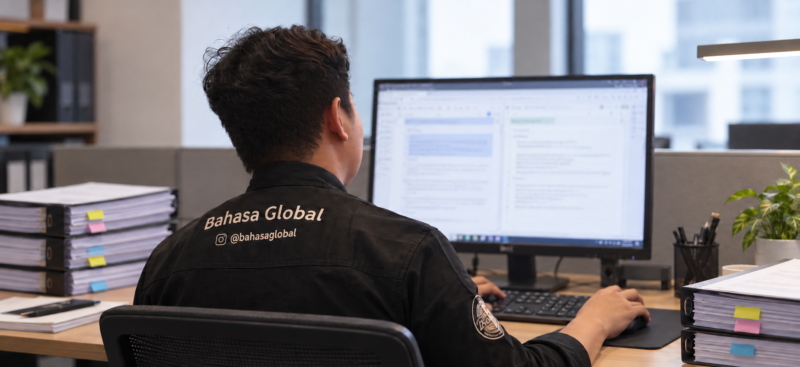
#BahasaGlobalTeam manages large-scale sworn translation projects through a structured and consistent workflow.
The first step was to convert the final target into a daily production requirement. For a project involving 20,000 pages over 60 working days, the calculation was:
20,000 pages ÷ 60 working days = approximately 334 pages per working day.
This figure became the basis for determining the required team capacity. However, daily targets could not be established solely by dividing the total number of pages.
Each document had a different level of complexity. Documents containing tables, technical terminology, handwritten text, or low-quality scans required more time than documents containing straightforward text.
In addition, every translation had to be reviewed and certified before delivery. Therefore, capacity planning had to account for the entire workflow, not only the number of pages that could be translated.
Allocating Work Based on Capacity and Complexity
In a large-volume document translation project, work cannot be divided based solely on the number of files. One file may contain five simple pages, while another may contain dozens of pages filled with tables and specialized terminology.
Bahasa Global mapped the documents according to page count, complexity, priority, and delivery requirements. Based on this assessment, the work was assigned to sworn translators according to their language pairs, expertise, and actual capacity.
This structured allocation helped prevent an uneven distribution of work. Translators were assigned realistic workloads based on the characteristics of each document, not merely an equal number of pages.
As a result, the translation process could run in parallel without leaving more complex sections behind.
Translation and Review Running in Parallel
Waiting until every page had been translated before beginning the review process would have significantly extended the timeline. Therefore, the documents were divided into several batches.
Once one batch had been translated, it immediately entered the review stage. Meanwhile, the translators continued working on the next batch. Documents that passed the review could then proceed to administrative processing and certification.
This workflow kept every stage moving continuously. The review team did not have to wait for the entire translation phase to finish. Likewise, the certification workload did not accumulate at the end of the project.
Parallel processing was one of the key factors in maintaining an output of hundreds of pages per day without eliminating essential stages of the sworn translation process.
One Terminology Reference for the Entire Team
The more translators involved in a project, the greater the risk of inconsistencies in terminology, sentence structure, abbreviations, and formatting.
For this reason, every team member followed the same references. Bahasa Global used project instructions, glossaries, reference documents, and approved translation samples to maintain consistency.
When the team encountered a term that had not yet been included in the reference materials, the question was handled centrally. The final terminology decision was then shared with the entire team to prevent different translations from appearing in subsequent documents.
Shared references helped ensure that the translations remained consistent as one unified body of work, even when several sworn translators worked on the documents simultaneously.
Quality Control Remained Part of Daily Production
A target of hundreds of pages per day should never be achieved by reducing the review process. In sworn translation, errors involving names, figures, dates, or legal details can affect how a document is used.
Therefore, quality control was conducted for every batch. The review covered content accuracy, terminology consistency, names, figures, dates, tables, formatting, and completeness against the source documents.
If the team identified a recurring error pattern, the evaluation was immediately communicated to all members. This prevented the same issue from appearing across hundreds of subsequent pages.
As a result, quality control did not serve merely as a final check. It remained an integral part of the production process from beginning to end.
Phased Delivery Helped Meet the Client’s Priorities
A large-volume project does not always need to be completed in full before the first delivery. Documents can be grouped by priority and delivered in stages according to the agreed schedule.
This approach allowed the client to use the most urgent documents first. Meanwhile, the team continued translating and reviewing the remaining batches.
Phased delivery also provided a clearer overview of the project’s progress. Instead of receiving only page-count updates, the client received completed documents that were ready for use.
Large Capacity Requires a Measurable System
Experience managing a project with an initial volume of approximately 20,000 pages demonstrates that large-scale capacity does not depend solely on the number of translators involved.
Hundreds of pages can be managed each day when targets are divided realistically, work is allocated according to complexity, and project stages run in parallel. Terminology must also be controlled, while progress must be monitored consistently.
During implementation, the project volume increased to more than 25,000 pages. Bahasa Global adjusted its capacity and schedule, then completed all documents within the revised deadline agreed with the client.
The client’s identity, language pair, and document type are not disclosed to protect the confidentiality of the project.
Discuss Your Translation Targets with Bahasa Global!

Bahasa Global provides large-volume sworn translation services for projects involving thousands to tens of thousands of pages.
Sworn translation projects involving thousands or tens of thousands of pages require careful planning from the outset. The timeline must account for translation capacity, review, certification, and the client’s document priorities.
Does your project require hundreds of pages to be translated each day?
#BahasaGlobalTeam is ready to manage your sworn translation requirements through a structured, secure, consistent, and professional workflow.
Discuss your project volume and delivery target with us today!
📩 Email: info@bahasaglobal.com
🌐 Website: bahasaglobal.com