



Why Do Conference Interpreters Always Work in Pairs? Here's Why
Why Do Conference Interpreters Work in Pairs?
Learn why conference interpreters work in pairs during simultaneous interpretation. Discover how interpreter rotation ensures accuracy and professional communication.
Why Do Interpreters Often Work in Pairs at International Conferences?
Have you ever noticed that there are often two interpreters inside an interpreter booth, even though participants only hear one voice through their headsets?
For those unfamiliar with conference interpreting, having two interpreters in one booth may seem unnecessary.
In reality, working in pairs or as a team is a common professional practice in simultaneous interpreting, particularly during international conferences, multilingual seminars, and longer sessions.
The reason goes beyond simply dividing the workload.
During simultaneous interpreting, interpreters must listen to the speaker, understand the message, process the information, and deliver it in another language almost at the same time.
This requires an exceptionally high level of concentration.
Working as a team allows interpreters to rotate and support each other, helping maintain accuracy, concentration, and consistency throughout the event.
Why Don’t Simultaneous Interpreters Work Alone?
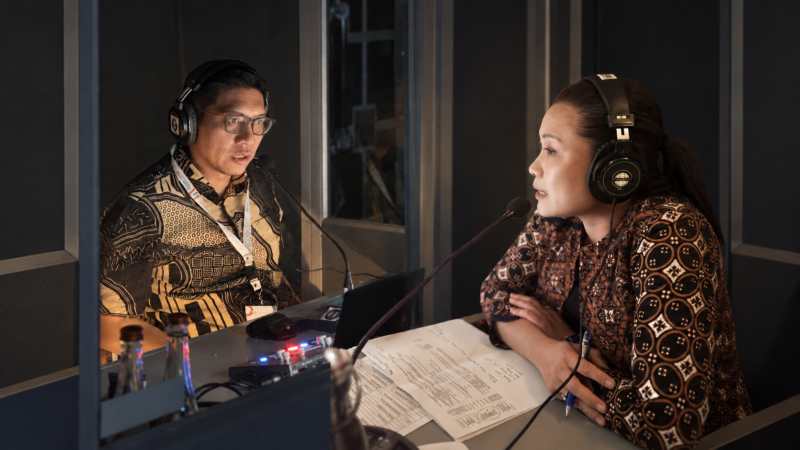
Professional interpreters by Bahasa Global in action, supporting live multilingual conferences from the interpretation booth with accuracy, consistency, and real-time communication.
In simultaneous interpreting, interpreters listen to the speaker through headphones, process the information within seconds, and immediately deliver the translation to participants.
Unlike written translations, there is no opportunity to pause, revise, or ask for extra time. Every sentence must be understood and conveyed almost instantly.
Because of this intense cognitive workload, industry standards recommend that interpreters work in teams rather than individually during long sessions.
The Level of Concentration Required Is Extremely High
A conference interpreter performs multiple tasks simultaneously, including:
- Listening carefully to the speaker.
- Understanding the intended meaning.
- Remembering the context of the discussion.
- Delivering a natural and fluent interpretation.
- Adapting technical terminology instantly.
All of these processes happen within just a few seconds.
Professional Interpreters Rotate Every 20–30 Minutes
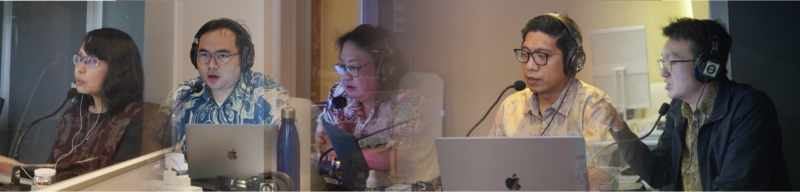
Simultaneous interpreters by Bahasa Global in action during a live conference, providing real-time interpretation services that ensure clear communication for multilingual events.
In professional conference interpreting, two interpreters typically rotate every 20 to 30 minutes.
This is not an arbitrary rule. It is a widely accepted industry practice designed to preserve accuracy, clarity, and mental performance throughout lengthy conferences.
While one interpreter is speaking, the partner remains actively involved by:
- Monitoring the ongoing discussion.
- Taking notes on important terminology.
- Assisting with names, numbers, or acronyms.
- Preparing to take over during the next rotation.
This collaborative workflow helps maintain consistent interpretation quality from the beginning to the end of the event.
What Are the Risks of Using Only One Interpreter?
Relying on a single interpreter for an extended conference significantly increases the risk of errors.
Potential consequences include:
- Reduced concentration.
- Less accurate interpretation.
- Missed names or technical terminology.
- Inconsistent delivery and speaking pace.
In business negotiations, government meetings, or international forums, even small interpretation mistakes can affect participants’ understanding and decision-making.
Teamwork Inside the Interpreter Booth
Inside the booth, interpreters do much more than simply take turns speaking. They function as a coordinated team throughout the session.
Their collaboration often includes:
- Preparing terminology glossaries.
- Tracking speaker names.
- Assisting with numbers and data presented quickly.
- Passing brief written notes when necessary.
This teamwork allows the active interpreter to stay focused while ensuring that important details are never overlooked.
When Are Two Interpreters Necessary?
Using two interpreters is generally recommended for events such as:
- International conferences.
- Multilingual seminars.
- Corporate board meetings.
- International training sessions.
- Government forums.
- Regional business conferences.
The longer the event and the more complex the subject matter, the more important professional interpreter rotation becomes.
Bahasa Global Provides Professional Conference Interpreters
As a trusted language service provider in Jakarta, Bahasa Global delivers professional conference interpreting services that follow international industry standards.
Our services include:
- Experienced interpreters across various industries.
- Professional interpreter rotation.
- Interpreter booths tailored to your event.
- Complete simultaneous interpretation equipment.
- On-site technical support throughout the event.
With proper preparation and experienced interpreters, multilingual communication becomes smoother, more accurate, and more comfortable for every participant.
Planning an international conference or multilingual event?
Consult with #BahasaGlobalTeam to determine the right professional interpreter and simultaneous interpretation system for your event.
📩 Email: info@bahasaglobal.com
🌐 Website: bahasaglobal.com