Multilingual Translation Services: From ASEAN Languages to the Official Languages of the UN
Businesses and international organizations communicate with a wide range of stakeholders, including government partners, donors, communities, program participants, and companies across different countries.
English often serves as a common language. However, a single language may not be enough to communicate every message effectively.
Contracts, reports, training materials, and publications need to be clearly understood by their intended readers. Language errors can lead to misunderstandings and disrupt program implementation.
Multilingual translation services help maintain clarity across languages. So, how does multilingual support help businesses and international organizations?
Multilingual Support Goes Beyond Translating into Multiple Languages
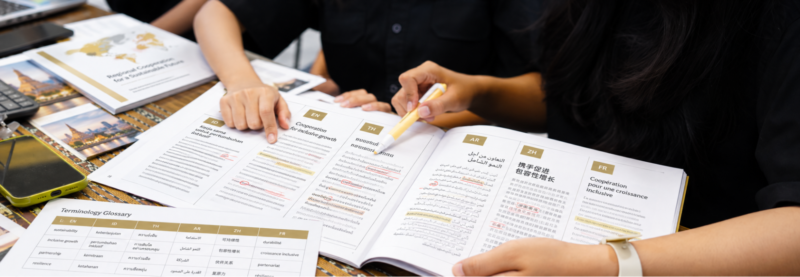
#BahasaGlobalTeam reviews multilingual documents for businesses and international organizations.
Multilingual support helps organizations communicate information to different audiences in their respective languages. It involves more than translating text.
This support may include:
- identifying source and target languages;
- selecting translators with relevant subject expertise;
- developing glossaries;
- editing and quality checks;
- managing document versions;
- adapting formatting and layout;
- providing sworn translation where required.
The goal is to ensure that every language version conveys the same meaning, serves the same purpose, and maintains an equivalent level of formality.
English May Not Be Enough Across ASEAN
English is ASEAN’s working language under the ASEAN charter. However, regional communication still involves many languages.
Businesses and organizations may need translations into Indonesian, Malay, Thai, Vietnamese, Khmer, Lao, Burmese, Filipino, or Tetum. The choice depends on the destination country and the intended audience.
In this article, “ASEAN languages” refers to languages used across the ASEAN region. It does not refer to a single official language.
Translation into ASEAN languages may be needed for activities such as:
- expanding into new markets;
- implementing regional programs;
- conducting research with local respondents;
- training participants from different countries;
- collaborating with governments or local partners;
- communicating information to communities.
Local languages make information easier to understand. They also help organizations reduce the risk of miscommunication with partners in their target countries.
The Six Official Languages of the UN and Their Uses
The United Nations has six official languages: Arabic, Chinese, English, French, Russian, and Spanish. These languages are used in various official UN meetings and documents.
However, this does not mean that every international organization needs to translate all its documents into all six languages.
Language selection depends on:
- the purpose and function of the document;
- the country where the program takes place;
- the organization’s requirements;
- the intended audience;
- the scope of distribution;
- the need to make information accessible.
International organizations also frequently need local languages. For example, Indonesian is needed to communicate with government institutions, national partners, and communities in Indonesia.
Translation into the official UN languages can therefore complement translation into local languages. The choice should reflect the needs of the intended readers.
Documents That Require Multilingual Support
Multilingual translation services can support a wide range of documents, including:
- contracts and cooperation agreements;
- research reports and annual reports;
- policies, guidelines, and standard operating procedures (SOPs);
- training modules and materials;
- questionnaires and survey instruments;
- tender and procurement documents;
- program publications;
- websites and campaign materials;
- public communication materials.
Each document requires a different approach. Contracts demand precise legal terminology, while research reports require consistency in data and terminology.
Public communication materials, meanwhile, should read naturally and be easy to understand. Translations should avoid awkward wording or sentence structures that follow the source language too closely.
The type of service should also reflect how the document will be used. Certain official documents may require sworn translation.
When Do Businesses Need Multilingual Translation Services?

Illustration of a business in the Translation Services industry
The need arises when a single language cannot effectively reach everyone involved. Common situations that call for multilingual support include:
- Expanding into ASEAN Markets
Businesses need contracts, company profiles, marketing materials, and operational documents in the language of their target country.
- Implementing Regional Programs
Training materials, guidelines, and publications need to be adapted to the languages used by participants in each country.
- Working with International Partners
Proposals, agreements, reports, and correspondence need to be understood by all parties involved.
- Communicating with Communities
Guides, surveys, and outreach materials should use language that the target audience can easily understand.
- Meeting Official Requirements
Certain documents need to be translated for tender submissions, procurement, permit applications, embassy procedures, or legal proceedings.
Language selection should therefore take into account the destination country, the document’s purpose, and the intended audience, alongside the organization’s internal working language.
Choosing a Translation Provider for International Documents
A document translation provider needs to offer the right language pairs. However, access to a large pool of translators is only one consideration.
Before choosing a provider, review the following:
- experience in the document’s subject area;
- editing and quality assurance processes;
- use of glossaries;
- confidentiality safeguards;
- ability to handle different file formats;
- capacity to meet deadlines;
- clear revision procedures;
- availability of sworn translation services.
A professional translation provider should also understand the document’s purpose. This understanding guides terminology, writing style, and the appropriate level of formality.
Support Your International Communication with Bahasa Global

Bahasa Global provides multilingual translation services for businesses, government institutions, and international organizations.
Each project is assessed according to its languages, subject area, volume, format, and intended use. Support may include translation, editing, quality control, glossary development, and layout adjustments.
Both sworn and general translation services are available to suit different needs. With the right support, every language version can communicate information accurately, consistently, and in a way that is relevant to its readers.
Need to translate a document into several languages?
Discuss your language requirements, document volume, and deadline with #BahasaGlobalTeam. We can help you identify the right service for your project.
📩 Email: info@bahasaglobal.com
🌐 Website: bahasaglobal.com